
Toronto's Indigenous Hub
Purpose-built Indigenous Community Health Centre brings reconciliation to life
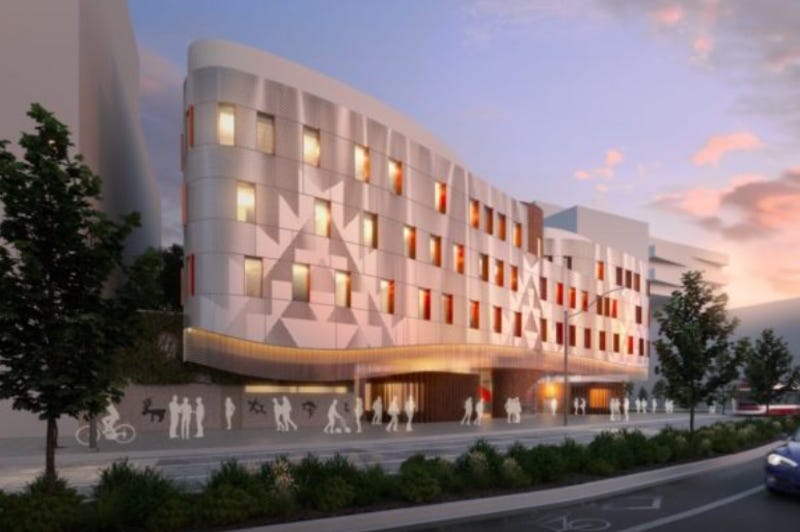
On land that was once a hunting ground for Indigenous people, Canada’s largest city now has a health centre built specifically for its 90,000 Indigenous residents, set in a unique city block that embodies their traditions, practices, and principles and stands as a powerful expression of reconciliation and cultural reclamation.
As well as the Indigenous Community Health Centre and Miziwe Biik Aboriginal Employment and Training Centre, the Indigenous Hub in Toronto’s Canary District includes an 11-storey rental building, Birch House, and a 13-storey condominium, Canary House. The Centre celebrated its grand opening in June 2025.
Anishnawbe Health Toronto (AHT) is the city’s only fully accredited Community Health Centre governed by Indigenous leadership, and among the few in Canada with full-time Traditional Healers on staff. “The new Centre realizes the long-held vision of the late Elder Joe Hester: a unified space where culture, ceremony, and care come together, rooted in the teachings of Traditional Healers, Elders, and Medicine People, and guided by an Indigenous understanding of the social determinants of health.” AHT supports clients facing trauma, homelessness, chronic illness, and addiction.
“This is more than a health centre - it’s a powerful act of reclamation, restoring space for Indigenous presence, knowledge, and healing in the heart of the city,” says Michael Milward, Interim Executive Director of the Anishnawbe Health Foundation.
The four-store facility and its outdoor space accommodate public and private ceremonial and traditional practices, including a Sweat Lodge and Ceremonial/Healing Gardens. Located in a part of the city that was once the floodplain of the Don River, and before that the ancestral lands and hunting grounds for Indigenous people for thousands of years, it also reclaims former industrial lands.
Integrating traditional and western medicine is part of the Centre’s model of providing wrap-around care. Services include primary health care. a dental clinic, palliative care, a mental health program, and assistance for people searching for housing. A child and youth program includes services that include support for expecting and new mothers, an Outward Bound program for teenagers, and youth outreach workers who can accompany someone to court or help with a college application. It centralizes programs previously delivered in three separate locations.
“Joe [Hester]’s philosophy was to have a one-stop shop—we call it our circle of care,” says AHT executive office manager Christopher Doucett. “So when people come in, if you’re having mental health issues and your [physical] health is not being addressed, you can’t really fix the mental health. Or if your health is in bad shape, and you have no housing—when you’re living on the streets, it’s hard to take care of that. So we’re trying our best to do everything under one roof, to completely care for someone.” Hester “wanted it to be inviting to the neighbourhood,” Doucett added.
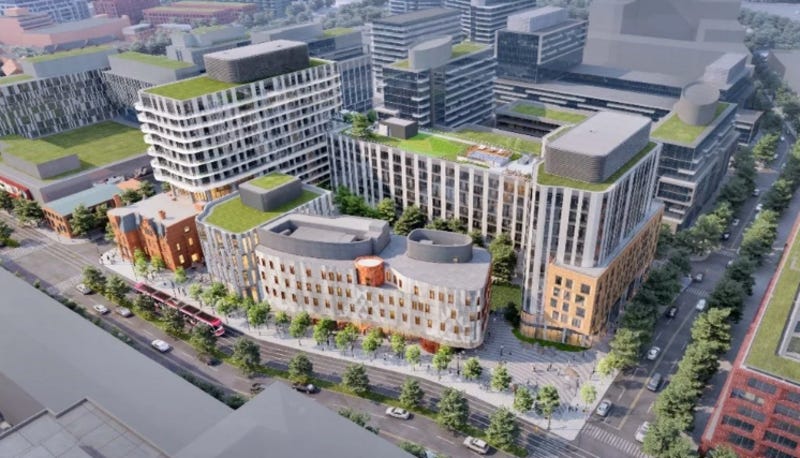
The Indigenous Hub, Waterfront Toronto
“The intent was all about how do we ensure that when people are in this block, they understand that it is a place of indigeneity, and also understand where they are within the city,” says Matthew Hickey, a partner in Indigenous architecture firm Two Row, which created guidelines based on First Nations principles that are embedded through the complex.
Michael Moxam, project design principal and design culture practice leader for Stantec Architecture, which designed the Centre with Two Row, calls it “a new and much-needed layer of Indigenous culture and presence” within the city’s urban fabric.
“Our goal was to create a community of inclusiveness,” says BDP Quadrangle co-founder Les Klein. BDP Quadrangle and Two Row designed Miziwe Biik and the residential components. “This project is not just symbolic, it is structural; not a gesture, but a grounded return. It is a space of healing, a platform for community-led growth, and a new urban typology born of Indigenous values.”
While it began with a diabetes research project more than three decades ago, AHT soon realized that a more comprehensive approach to health care was needed. When Anishnawbe Health Resources was incorporated in 1984, one goal was “to recover, record and promote Traditional Aboriginal practices where possible and appropriate.” In 1989, AHT became recognized and funded as a community health centre. Today, its model of health care is based on Traditional practices and approaches and is reflected in the design of its programs and services.
Planning for the new Centre began after the Ontario government returned a 2.4-acre parcel of the former industrial area known as the West Don Lands to AHT in 2014. While it had restrictive land use conditions and no funding, an agreement eventually evolved that allowed AHT to use part of the land for a condo development, with presales helping to finance the site’s other buildings, and an apartment building, a future source of revenue.
BHP on Instagram
The design process was guided by Indigenous knowledge systems, symbolism and ceremony, embedding cultural resilience at every scale - from site planning to material expression, says BDP Quadrangle. Earlier this month, Canadian Architect carefully enumerated a wide range of the Indigenous design elements.
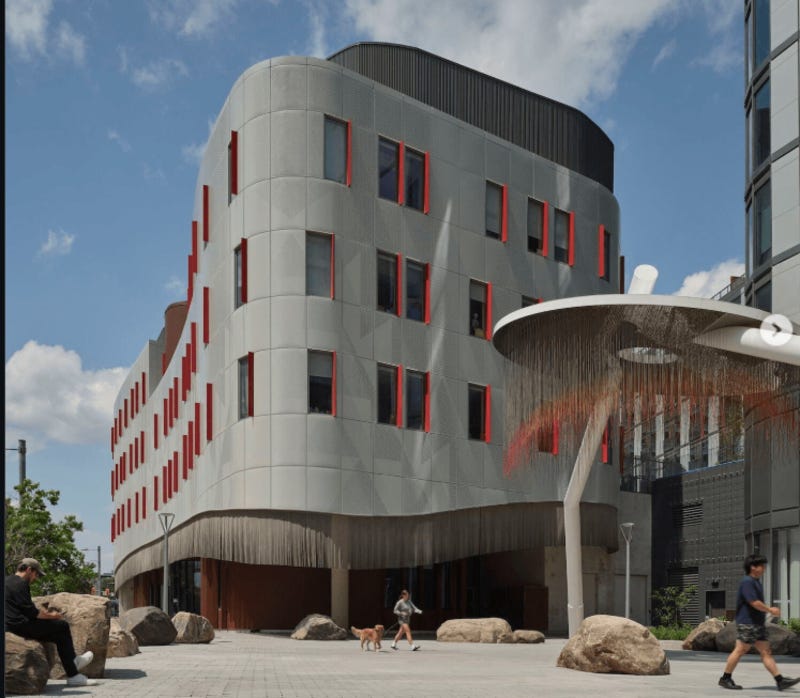
A fringe made of 12,000 metal beads hangs from the centre’s eaves and sounds like a babbling brook when the wind blows. “Everyone who walks past here, if they’ve never seen the building, they just stare at everything,” says Doucett. “Especially the fringe. If it’s a really windy day, you can hear it. You can almost see it dancing in the wind.”
It echoes the fancy shawl and jingle dresses worn by Anishnawbe dancers for healing ceremonies. “The shawl, also used traditionally for carrying medicine, wraps around the body, but it opens at the heart,” says Two Row Architect principal Brian Porter.
The building’s four-storey atrium opens to a central courtyard to the east, aligning with the sunrise, which includes a waterfall fountain, screened sweat lodge court, bioswales, and medicinal plantings. The landscape includes native plants – tobacco, sage, cedar, sweetgrass – and seven benches that represent seven Anishinaabe teachings: Love, respect, bravery, truth, honesty, humility and wisdom.
“Surrounding the atrium, rounded pavilions housing traditional and western services allude to stones in a river—a nod to the site’s location on the historic Don River delta,” says Canadian Architect. “A red staircase, the side of which is a stunning steel-cut mural by Anishnawbe artist Christi Belcourt, refers to an Indigenous teaching about ‘walking the red path’—meaning cultivating healing by living a good, clean, healthy life.”
A series of traditional healers’ rooms recall healing lodges from different Indigenous traditions, with ventilation systems that allow for smudging and dimmable lights, and are spacious enough for healers to meet with families and individuals alike.
Miziwe Biik, whose textured precast façade suggests birch bark, offers Indigenous training and education, focused on the construction trades. It includes daylight-filled double-height carpentry shops, metal and wood-frame electrical mock-up structures, and classroom spaces.
The building also includes an EarlyON drop-in centre for families, and a daycare that will prioritize Indigenous families, though not exclusively Indigenous. Both spaces are equipped with outdoor playspaces, large stroller parking areas, and open kitchens. The EarlyON centre’s kitchen will host training for caregivers, while their kids are cared for within view.
“There are so many beautiful metaphors in this building,” says Klein. One of his favourites is the large rocks from across Canada that serve as seating in the public plaza. “It expresses not only the way rocks were pushed by the glaciers, but also how Indigenous people were pushed across the landscape against their will, and sometimes where they landed was where they lived.”
He says the Indigenous Hub is intended to “engender conversation about reconciliation—all those elements that we need to talk about, but that rarely have physical form.”
Many health care systems across Canada are responding to the Truth and Reconciliation Commission’s recommendation that they value and use Aboriginal healing practices in treating Aboriginal patients in collaboration with Aboriginal healers and Elders. The Indigenous Community Health Centre is showing what that looks like.