
Thinking outside the box
The Vancouver hospital that is an integral part of its neighbourhood

Amazing things happen when people think outside silos. Take for example what happened when St. Paul’s Hospital in Vancouver partnered with The Binners, waste-pickers who collect used containers from bins and are one of the most marginalized groups in urban areas.
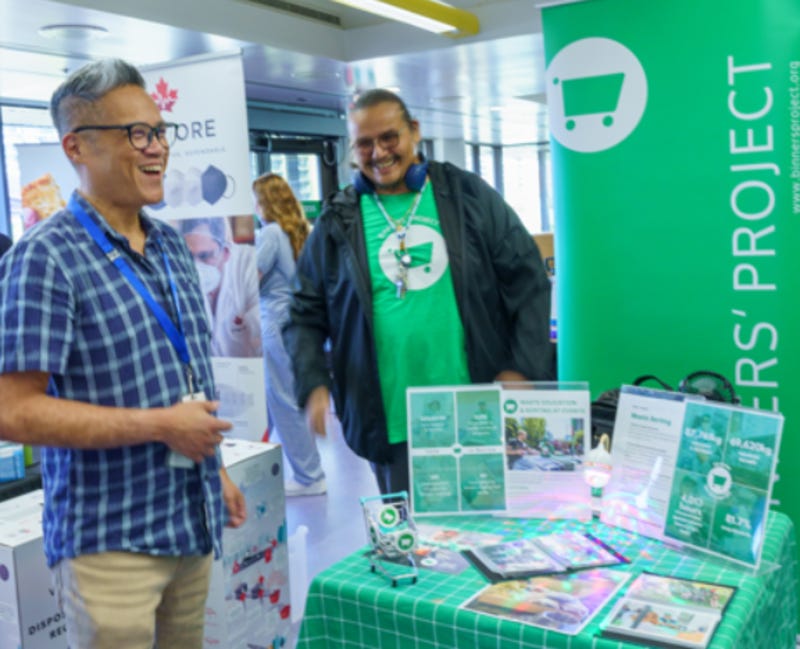
Benson Low (left) and a Binners Project representative at the 2025 Sustainability Fair at St. Paul’s Hospital. Benson supports the binners and their work. Photo by Brian Smith, Media Services, The Daily Scan.
Not only did the hospital’s recycling rate double within a year, it created thousands of hours of work for the people who work as informal recyclable collectors, even as it helps lower the city’s landfill costs. Now the binners are part of the fabric of the organization.
St. Paul’s is the first large acute care hospital in British Columbia that has its waste taken to recycling stations. Before COVID, all its waste was treated as medical waste that could not be recycled. But starting in 2023, the binners safely sorted waste on-site and found many recyclable and compostable items that had been thrown into regular trash bins.
In 2024, Providence Health Care, the non-profit owner of St. Paul’s and Mount Saint Joseph Hospitals, provided 4,069.5 hours of income opportunities through 1,118 shifts at St. Paul’s Hospital and Mount Saint Joseph Hospital. That made Providence the largest single contributor to the program’s yearly success.
“We saw it as our responsibility to create jobs within this area,” says Benson Low, director of environmental services for Providence. “The more hyper-local the better. We should be supporting community and that was the main driver in how we came to work with the binners.”
Sean Miles, director of the Binners’ Project, says the partnership has created meaningful, low-barrier employment opportunities for people in the Downtown Eastside who face systemic barriers to traditional work.
The Binners’ Project creates long-term change by offering fee-for-service waste sorting programs to help organizations achieve three benefits. Binners feel connected to the wider community while building job skills, routine, and a sense of dignity. They earn a reliable and fair income through participating in the organization’s programs. And they use their expertise to sort waste and help organizations achieve their sustainability goals.
In 2025, binners worked at 14 waste sites, creating 13,692 hours of total income opportunities, valued at $155,687.
Providence’s Waste Team includes Low, Erick Nguyen, Kathy Kohli, and Brieta Zambrano. As part of their ongoing efforts to reduce waste and increase recycling, they hire local groups, part of Buy Social and Exchange Inner City networks, that give jobs to people who face barriers to finding work.
They are one of the biggest buyers of services from groups in the Downtown Eastside, which also include:
Clean Start: rubbish removal, diversion, and recovery
Mission Possible: cleans windows and outdoor areas
Recycling Alternative and TerraForma Systems: recycling services provider, consultants, and waste handling equipment supplier
Have Café: trains people to work as cooks
Embers: helps people find and keep jobs
Providence Health was one of three groups in Canada to win Buy Social Canada’s 2025 Social Procurement Champion Award, which recognizes organizations that use purchasing decisions and business activities as a force for good.
“These award winners lead by example and model what responsible business can look like in Canada,” says Elizabeth Chick-Blount, CEO of Buy Social Canada. “They show us that procurement isn’t just a transaction, it’s a powerful tool for building more resilient and inclusive communities.” Other winners were SaskPower and Assiniboine Credit Union.
Partnering with VitaCore, a local company that recycles plastic from masks and IV bags, the Waste Team has been recycling personal protective equipment (PPE) like masks, gowns, gloves, and IV bags. VitaCore will make benches and planters from the recycled materials, which will go to long-term care homes.
Providence and VitaCore are the first in Western Canada to run such a program. Providence is the only health organization in the region that has adapted IV bag recycling, using technology developed by VitaCore.
Now, the team is teaching other health groups how to do the same thing. The YWCA and some health authorities are starting to use this model.
The new St. Paul’s Hospital which is under construction is the first project in Vancouver to trigger the City’s Community Benefit Agreements Policy which aims to promote growth for the communities where projects are built. In 2024, the project exceeded targets for hiring from equity-seeking groups, as well as partnering with local suppliers.