
‘Reconciliation in action’
Huge Squamish Nation development will help address Vancouver’s housing shortage

More than a century after being forced to leave their village, the Squamish Nation is building carbon-neutral housing for thousands of Indigenous and non-Indigenous people on part of their traditional lands, in what is now one of Vancouver’s most desirable neighbourhoods.
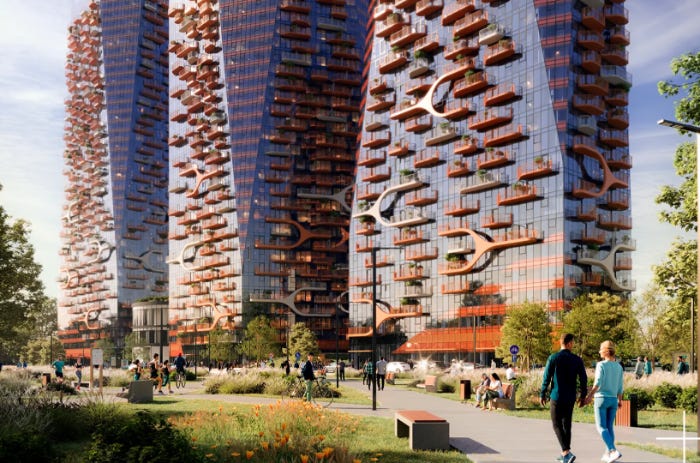
From Senakw website’s gallery. Used with permission.
As the Squamish Nation and its guests gathered for the blessing ceremony for tl’eltl’élnup (real home) on May 8, the first of a planned 11 residential towers that will make up Sen̓áḵw, council chairperson Wilson Williams called it “the beginning of something beautiful.”
Sen̓áḵw, the largest First Nations-led economic development economic project in Canada’s history, “is as much of a benefit to the City as it is a tool to create wealth from our lands that will enhance the entire community,” said Khelsilem, then Chairperson of the Squamish Nation Council, and Mindy Wight, CEO of the Nch’kaỷ Development Corporation, in a 2022 Daily Hive guest article. “Sen̓áḵw’s legitimacy as an effort of reconciliation is evidenced by the broad collaboration between Indigenous and non-Indigenous governments and the net positive impact we will have on Indigenous and non-Indigenous communities,” they added.
Sen̓áḵw is situated on 10.48 acres of former Canadian Pacific Railway land that the BC Court of Appeal ordered returned to the Squamish Nation in 2003. It was just 15% of Indian Reserve No. 6 as it had been in 1912. “In 1913 our people got put on a barge and pushed into the ocean, our homes were burned as they were going off into the ocean. So it’s been a long battle,” said Jacob Lewis, who is currently the director of community development with Nch’ḵay Development Corporation, the Squamish Nation’s economic development arm.
After detailing the complex history of the village and its return, the Works in Progress newsletter noted that when the Squamish Nation sailed 28 canoes to the beach in Kitsilano in a symbolic homecoming in 2002, observers did not initially notice the site’s development potential.
Before the 2008 financial crisis, Sen̓áḵw was originally planned to be a smaller development. Then in 2019, the nation’s members voted in favour of the much larger plan, which will ultimately house up to 9,000 people. That represents 7% of Vancouver’s entire projected housing output up to 2033. Of the 6,000 homes, 1,200 will be affordable rental units, with 250 allocated to Hiy̓ám̓ Housing for Squamish People.
Tower 1, tl’eltl’élnup or Home, has 107 studios, 153 one-bedrooms, 70 two-bedrooms, two 3-bedrooms and one 4-bedroom unit. All residents will have access to shared rooftop decks, co-working spaces, entertainment rooms, indoor fitness centre, outdoor fitness areas and a wellness pavilion that will feature a pool, sauna, cold plunge and social spaces, as well as the Sḵwx̱wú7mesh Village exterior green space and on site concierge. Towers 2 and 3 are nearing completion.
It is slated to become one of the world’s first large-scale zero carbon housing projects. Heating and cooling will be provided through a 10MW district energy system, which recovers waste heat from Metro Vancouver’s adjacent sewer infrastructure. The project will return three to four times the energy needed to drive it, says the Journal of Commerce.
“With a desire to showcase climate leadership, the project is slated to become one of the first large-scale zero carbon housing projects in the world,” says Vancouver-based Creative Energy, which is heating the development with a sewer-heat recovery district energy system.
Sen̓áḵw is envisioned as a car-lite, transit-oriented community, emphasizing active transportation options, ample bike storage, and open courtyards designed to support social connection, commerce, and recreation.
“Sen̓áḵw is not just about real estate; it’s rooted in a story of the shared journey of our people coming home,” says Mindy Wight. “We have brought this development forward to meet the housing needs of Vancouver, while still advancing the economic interests of the Squamish Nation.” It is “reconciliation in action”, she says.
Wilson Williams echoes that. “This project is not just about buildings—it’s about bringing the Squamish People back to the land, making our presence felt once again in the heart of our ancestral territory, and creating long-term wealth for the Squamish Nation.” With a budget exceeding $1.4 billion, it is expected to generate upwards of $10 billion in revenue over its 100-year lifespan from rental income alone.
Chief Janice George often thinks of her ancestors when she sees Sen̓áḵw's towers on the shoreline. "They were always thinking about us. And now it's our turn to think about our grandchildren, our great-grandchildren, and the ones still to come." She calls Sen̓áḵw "a foundation piece for our descendants." One hundred years from now, she says, it will still be taking care of Sḵwx̱wú7mesh people and everyone who calls this place home.
A unique collaboration between the Squamish Nation and the City of Vancouver on a services agreement means the project will contribute more than $28 million for service upgrades that serve the broader community; invest $15 million in a new public transit station; and provide more than 50,000 sq ft of public amenities, including park space and indoor and outdoor recreation space on the unused lands beneath the Burrard Street Bridge. It will pay property taxes.
The entire development reflects Coast Salish designs and language.
YouTube Aug. 28, 2025. Used with permission.
Two other Indigenous-led housing developments underway in Vancouver will also add a great deal more housing, while making Indigenous culture visible and further showing ‘economic reconciliation’ in action.
The Squamish, Musqueam and Tsleil-Waututh have come together through their real estate firm, MST Development Corporation, in joint ventures with the Crown corporation Canada Lands Company. Both projects are following the municipal government’s standard application processes.
The Iy̓álmexw (Jericho Lands ) development will build on the legacy of the Indigenous village that once existed nearby at Jericho Beach. The project, at 90 acres and 13,000 potential homes with 20% social housing and 10% secured rental housing, will be a high-density, mixed-use and car-light community and will accommodate about 3,000 jobs in a mix of commercial spaces. Community amenities will include a community centre, public elementary school, five childcare facilities with almost 500 spaces, Indigenous social and cultural spaces, a non-traditional library or House of Learning, 30 acres of parks and open spaces.
“The Iy̓álmexw development is more than just a construction project. It is a vision for a better future where affordability, sustainability, community, and cultural revitalization come together to create a new, highly livable neighbourhood in Vancouver,” says Khelsilem. “By prioritizing the needs of residents, promoting mixed-use urban design, and celebrating the area’s natural beauty, the project sets a new standard for urban development in Vancouver.”
The 21-acre Heather Lands will feature 2,600 leasehold condos, many of which will be offered to eligible buyers for 60% of their market value (with the other 40% collected when the unit is sold or after 25 years). The plan also includes a French-language school and associated child-care facility, an MST cultural centre, and plaza, as well as 4.4 acres of park and open space.