
Practical Magic
I spent the weekend in Stuart McLean's world, bingeing on all his marvellous stories

Storytellers are such a gift. They manage to turn what seems every day into magic. It is what you might call Practical Magic, which is the title of the novel I brought to Bosnia with me in 1996 when I went to observe the first post war election.
Maybe it was because I read part of it sitting at the tables on the patio just outside the Hotel Leotar in Trebinje - a once grand hotel that had suffered during the years of war. Or maybe it was the setting - an old bridge that folks in Sarajevo had told me about, with tall trees behind like paintbrushes.
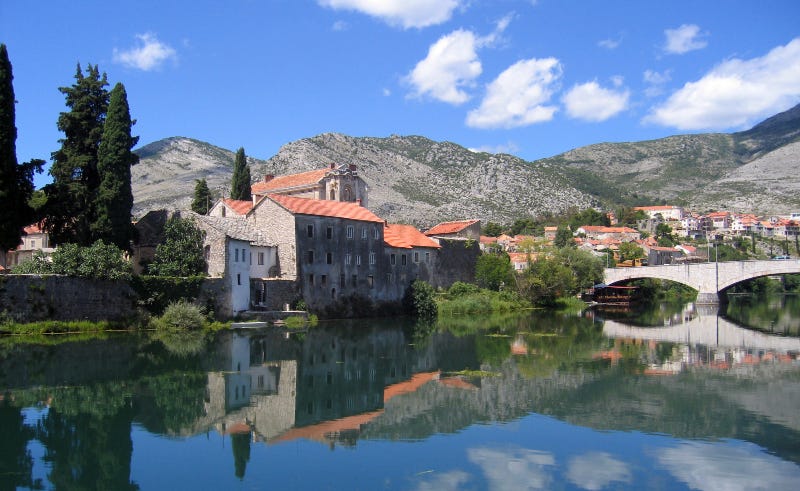
Goran Andjelic (Hrast), Wikimedia Commons
I didn’t speak the local language, so when Silvana, who ran the OSCE office, invited me to have lunch with her at the home where she now boarded, and her landlady asked me something that sounded like “paradise”, I was quick to agree. It did seem like paradise up there on the hill overlooking the town and sitting under an arbour of green vines.
Turned out she was asking me if I wanted tomatoes - because the local word for tomato sounded just like paradise. I have never forgotten the word. (And I ate all three of the tomatoes she produced proudly on a nice plate.)
That was the year that the Macarena seemed all the rage. The cafe on the alley just below my apartment seemed to play it over and over again. I remembered that time when Jerusalema became a huge global hit some years back.
Practical Magic is a novel that Alice Hoffman wrote in 1995. I think I must have bought it at Vienna airport, which was as different from where we landed in Sarajevo as it could be. When we were heading back to Canada after the election observation, they stamped my passport Maybe Air at the airport.
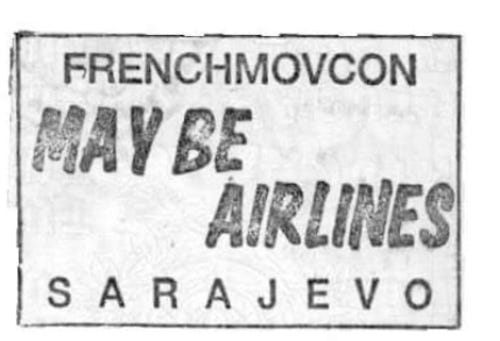
Maybe Airlines was the affectionate term for the UNPROFOR air wing operating into Sarajevo during the Bosnian War, between 1992–1996). It was run by Norwegian UN teams and military transport, and apparently got the name because people checking in and asking if a plane was going to fly or take passengers, were told “maybe”.
Paulo Gonçalves of the Portuguese Air Force, who wrote a book about peacekeeping in Bosnia in 1995, tells it this way in a blog post from March 24, 2020:
“Welcome to Maybe Airlines,” she said. “I just saw the crew, weather is not too bad and they are not shooting into the air in Sarajevo; therefore, Maybe there will be a flight today!”
““Maybe Airlines” was a tender nickname for UNPROFOR air wing that everyone loved. We not only loved it, we were proud to fly on it. There was even a “Maybe Airlines” stamp everybody wanted to collect on their military travel orders; even the (many) civilians visitors wanted to have it on their passports … and they got it!”
Practical Magic is a novel that is about witchcraft and about two orphaned girls raised by eccentric aunts in a small town in Massachusetts. But it is a novel with an atmosphere that is magic, but subtly so, and that seemed to make it perfect for me in that time and place.
I read the novel some years later but the magic that it seemed imbued with that summer in Bosnia did not seem to be there any longer. So I think it was the place, as much as the novel, that created my practical magic.
I once thought about the title Men Singing and Women Dancing, for a book about that time. It came from one lazy Saturday morning, when I went to the cafe that was popular with internationals like me, and had coffee on the back patio. I think I was still reading Practical Magic and I may have been at the place where something magical happens to the plants in the garden of the house.
Then suddenly, three or four men sitting at a table on the other side of the patio began to sing, a capella. The harmony was mesmerizing. I had never heard anything like it, and my coffee grew cold as I listened.
I was thinking about that time, and about the power of storytelling, over the long weekend. Cooped up inside because of the intense heat, I found myself bingeing on the stories told by the late Stuart McLean and his Vinyl Cafe.
I remember listening to a much younger Stuart on Peter Gzowski’s Morningside, which seemed to me to be something shared by Canadians of my age.
But it is different to listening to a lot of his stories all at once, rather than just once a week or so on Morningside.
It takes you into a world - imaginary, of course - but so human. Dave and Morley and their kids and their dog are the anchor for the stories, but they range over the whole gamut of human experience. They bring laughter, and tears, and always thunderous applause from the audience.
In a time when the world seems topsy turvy, when there seems to be a shortage of stories about people and family and communities who are joyfully seen whole and celebrated for all their foibles, I found myself immersed in a world where there is kindness, and understanding, and things come out all right in the end, no matter what.
I liked how Wikipedia describes him. “Often described as a ‘story-telling comic’ although his stories addressed both humorous and serious themes, he was known for fiction and non-fiction work which celebrated the decency and dignity of ordinary people, through stories which often highlighted the ability of their subjects, whether real or fictional, to persevere with grace and hunour through embarrassing or challenging situations.”
Stuart left us a long time ago now, but thankfully, his voice and his joyful storytelling live on on YouTube. So he’s not quite left us, as long as we have his stories and his voice.
I just found Practical Magic on Libby from the Toronto Public Library and put it on hold (I’m the next in line.) Thank you for your story and for the recommendation!