
‘It was the wrong Gaza’
A powerful story told through the experiences of one person and one family

A story as told through the experience of one person is really powerful compared to a story that relies on a lot of statistics. No matter how big or small the story.
I learned that a long time ago when I worked as executive director of the Status of Women Council of the NWT. I was often asked to make presentations, and one of them was to an international group of people who were studying diamond mining in the NWT.
I struggled for quite some time to put together a presentation. I found statistics and reports about community impact, but when I tried to put them together into a slide show, they seemed quite abstract and removed from real life.
So I scrapped that idea and decided to try and tell the story of impact as if I was a woman in a small northern community. I drew on many stories I had heard about the impact of the mines on small communities far removed from Yellowknife. I found graphics to illustrate the talk.
When I gave the presentation in a meeting room at the Explorer Hotel, I was nervous. I thought perhaps it would sound naive. Maybe people would be expecting statistics, not a story that tried to make the statistics seem personal.
I was so surprised when the group applauded enthusiastically when I had finished. They said complimentary things about the presentation.
I remembered that experience when I was working in western Serbia on a USAID-funded project called Community Revitalization through Democratic Action more than two decades ago. I worked for UMCOR, which was a sub-grantee to International Relief and Development, the grantee. But our two sets of employees shared an office in Uzice.
One of the women who was leading the office for IRD had been invited to one of its meetings in Washington. She was not sure what kind of presentation she should make and was looking for advice.
So I told her the story of the diamond mine presentation and how telling the story through one person’s experience seemed to have been welcomed.
I was told she used the idea and made a presentation in Washington that really impressed the agency’s management.
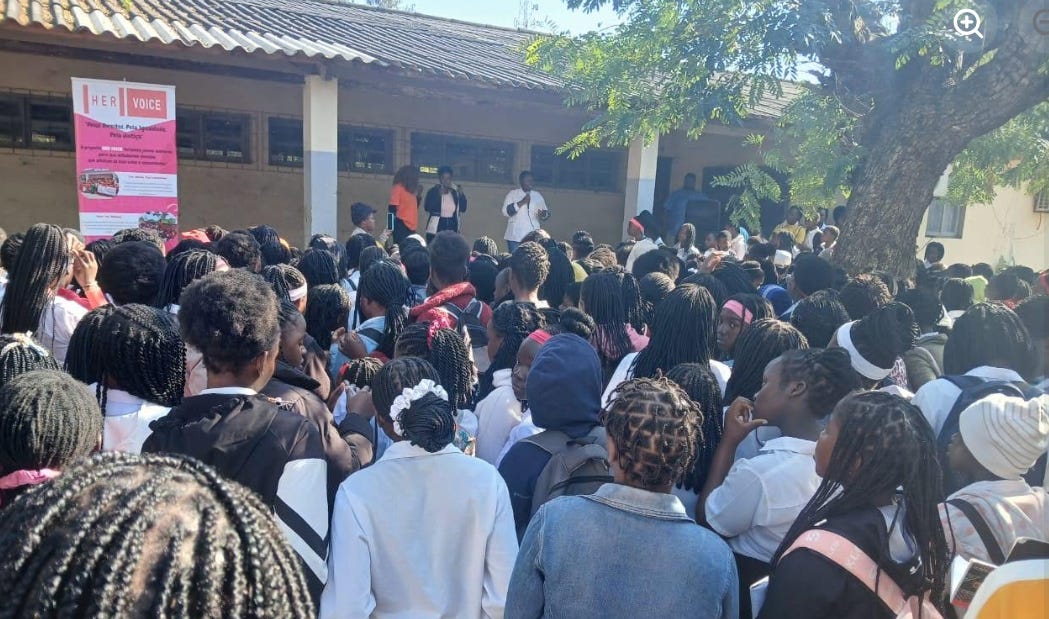
OCSIDA Facebook page. June 2025
I thought again about the power of telling a complicated story through the stories of one or two people as I watched Elon and the Other Gaza on Al Jazeera today.
The documentary begins with the claims of fraud in international assistance made by Elon Musk, the world’s richest man, after US President Donald Trump put him in charge of the ‘Department of Government Efficiency’. Musk claimed that USAID was wasting billions, and focused in particular on what he said was $50 million on buying “condoms for Hamas” in Gaza. Trump said Hamas was using the condoms to build bombs.
But the Gaza the Trump administration was talking about wasn’t the Gaza they thought it was, says the documentary. It was actually 6,000 kilometres from the Gaza Strip.
“There’s a province of Mozambique called Gaza. Mozambique has some of the highest rates of preventable HIV deaths per population in any country in the world. And the $50 million President Trump mentioned were in fact earmarked for HIV programs in Mozambique.”
The film makers went to that other Gaza to find out what happens when life-saving aid is abruptly cut off for more than 2 million infected people, in a place where almost one in four adults live with the virus.
They tell the complicated story in large part through the experiences of the former director of the organization that managed one of the province’s largest HIV programs until January 2025, and one of the families immediately affected by the cuts.
Zaida Maibaze was the director of OCSIDA (Organização Comunitária para Saúde e Desenvolvimento - the Community Organization for Health and Development). OCSIDA was a network of 500 health workers who supported 140,000 families affected by HIV. But by early February 2025, most of its operations had been suspended.
Rascina Nadza’s husband, Pelagio, had HIV. But when Ocsida’s health workers lost their jobs, he lost access to vital care. Without food and support, his health rapidly spiraled downwards. Rascina and her daughter are also living with the virus. But without help from Ocsida, she can barely scrape together the family’s only meal of the day.
The abrupt USAID cuts were devastating. 70% of Mozambique’s HIV response was funded by PEPFAR (the President's Emergency Plan for AIDS Relief) and delivered by USAID, the documentary says. In 2024, two million Mozambicans were on HIV treatment which was available in 97% of health facilities countrywide.
“Before January 2025, Mozambique was moving toward a future where HIV was no longer a death sentence,” the documentary notes. “It was projected that by 2030, treatment would be close to universal for anyone with the virus. Today, that future looks out of reach.”
.
The other Gaza: Inside Mozambique’s HIV crisis. People & Power Documentary, Al Jazeera, Jul. 22, 2026