
Breakthrough Methods
“We build public solutions by, for, and through citizens.”

Fiddly bureaucratic rules drive me crazy. And so I loved Michaela Haas’ story about How the Netherlands Bent Bureaucracy Into Something Beautiful, because it is about how the Dutch are making the system work in a joined-up way.
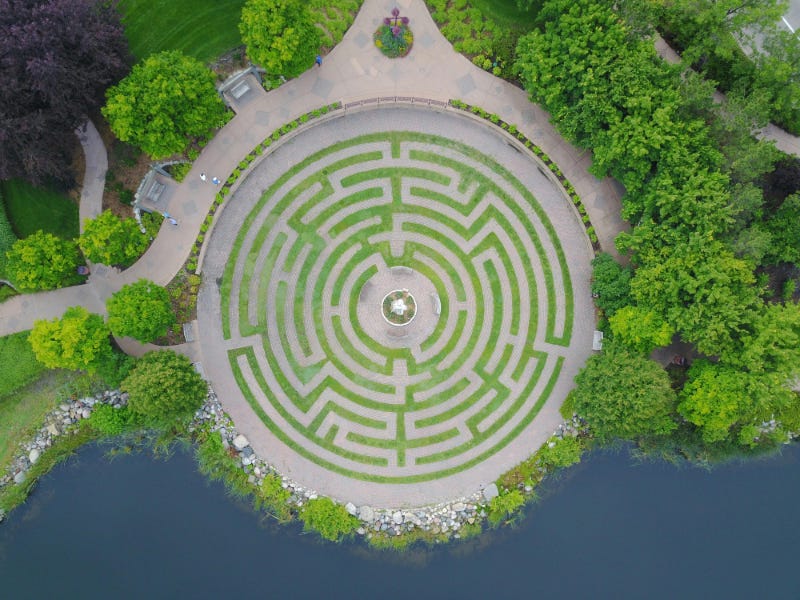
Circular Garden Maze in Park by Bl∡ke/Pexels
The Breakthrough Method creates insight into a system that is not able to see the big picture by itself. It is what happens when you can’t see the forest for the trees, so to speak.
The story begins with Eric, whose wife had died, leaving him to bring up two special needs daughters himself. By the time he met Harry Kruiter, 20 social workers had told him that to get debt relief, he had to sell his car, worth about €2,100 ($2,400). He used the car to take his daughters to their school 20 miles away. If he did not have the car, the municipality would be paying roughly €6,000 ($6,900) a year in taxis.
Applying the Breakthrough Method identified the solution that saved everyone money and reduced stress.
Eric was able to buy back his car, and then enter debt restructuring. He had to deal with only five professionals instead of 20. The municipality saved money. His daughters were happy because he could drive them to and from school.
“It’s not about bending the rules,” Kruiter says. “It’s about using them to achieve what they were intended to achieve in the first place.”
Kruiter co-founded the Institute for Public Values in Utrecht, Netherlands, in 2010, along with his brother and the director of a homeless shelter, to help people and families who were stuck in bureaucracy, debt, unstable housing, unemployment or addiction. Previously he did participatory action research for Leiden University, and before that he was a policymaker in urban redevelopment himself.
Their Breakthrough Method grew out of their ‘action research’.
“Why do citizen-driven solutions so often stall in government systems? That question drove the Dutch Instituut voor Publieke Waarden (IPW) to spend over fifteen years navigating the defensive machinery of bureaucracy. Their answer: action research, strategically applied, can turn institutional resistance into opportunity. Through hands-on work with thousands of vulnerable households, IPW developed the “Breakthrough Method”—a practical framework to cut through rigid legal, financial, and procedural barriers.”
Evaluations show that the methods work. A pilot targeting 150 heavily indebted residents, cited in the story, was found to have saved around €22,000 ($25,000) per participant, driven largely by reduced health care use and fewer social service interventions.
“We tackle societal problems at the root and dive into practice ourselves to do so,” says the IPV website. “Through action research, we develop practical solutions that really work. Together with citizens, professionals, policymakers, and administrators, we discover what helps. Drawing on people’s own logic, a wealth of practical experience, and insight into laws and regulations, we ensure breakthroughs at the individual level, smart collective solutions, and simpler systems.”
Today, the method is used in around 100 municipalities across the Netherlands, supported by a digital tool.
By starting with individual cases, “we learn increasingly better how, where, and why problems arise. Our case studies often act as ‘the canary in the coal mine’—we are frequently the first to see where the system stagnates. We share the knowledge we gain with others through publications, podcasts, lectures, and education.”
So often, no one in the system asks people what they need, he explains in a podcast.
Doing more with less money and fewer people “challenges us to work together to solve our own public problems. Many of these problems require collective solutions. This is cheaper, more efficient, and leads more quickly to a result with societal impact.”
Their approach brings government into the 21st century. “Whatever the public issue, we investigate how we can circumvent or break through obstacles. We translate the insights gained into practical solutions, so that policymakers and professionals at the local level can implement them effectively. Finally, we translate the solutions to the national government to increase the impact of all measures.”
Reading about the Breakthrough Method reminded me of South Africa’s Zwelethemba Model, which I discovered many years ago. It, too, was anchored in practicality.
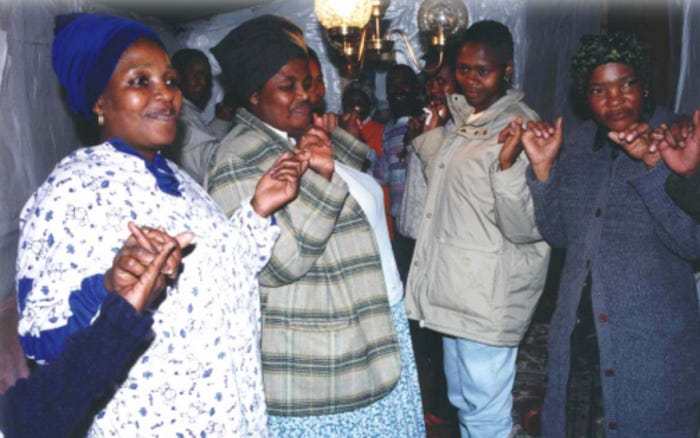
Community Peace Programme
Like many townships, Zwelethemba’s people responded to apartheid by making their township ungovernable. Once apartheid ended, however, they wanted someone to solve their daily problems. That ‘someone’ turned out to be themselves, aided by the Community Peace Program at the University of the Western Cape.
The Zwelethemba model drew on two key ideas. Firstly, that local people can manage their community by relying primarily on what they know and can do for themselves (‘local capacity governance’). And secondly, the idea that governance can start at the grassroots and work from the bottom up (‘micro-governance’).
The challenge was to use these ideas to help the community meet its own needs in such areas as policing, garbage removal, water and electricity, where government was not providing such services. By doing so, the people could create a simple model that also could work elsewhere.
The problem-solving model that emerged in 1997 was built around Peace Making (dealing with individual disputes) and Peace Building (addressing larger problems that showed up through a pattern in disputes or through regular surveys).
The committees gave ordinary people a way to become part of managing their community, by creating a new ‘node’ of governance that connected them with other resources.
Right in line with the values that ICA has been working with for a long time. And creative ways of approaching the work.