
A perfect partnership
Restoring grasslands and bison in tandem on the Mexico-US border

At the end of 2025, yet another bison herd arrived at a ranch in northern Mexico, as part of an ambitious strategy to restore Mexico’s grasslands along with the massive animals that once roamed there but disappeared due to excessive hunting, agricultural expansion, cattle ranching, mining, and habitat loss.
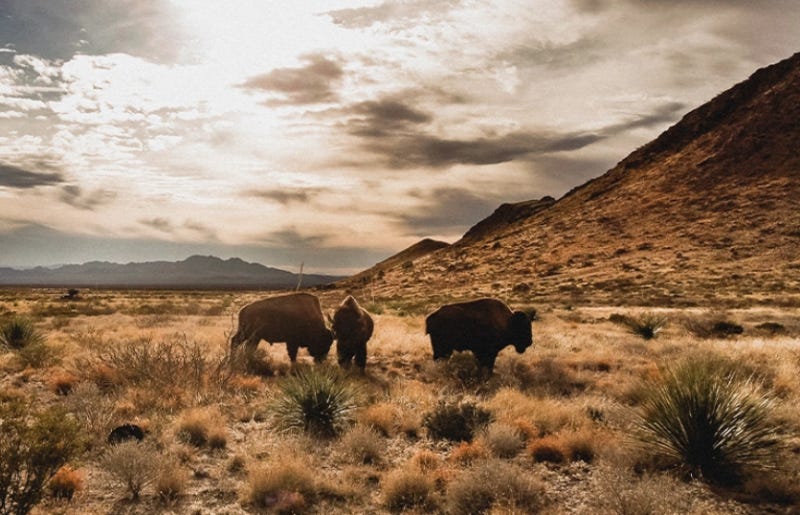
El Carmen Nature Reserve photo
The bison are now seen as “biological tools” to regenerate the grassland, using the impact of their hooves, nutrient-rich dung, and natural grazing patterns. “You have bison, you have grasslands; you have grasslands, you have carbon in the soil. You lose the bison and you start to lose the grasslands,” says Rurik List, a researcher in environmental sciences at the Autonomous Metropolitan University (UAM) in Mexico City.
Forty four bison—38 females and 6 males—were released on the “El Santuario” reserve, a former cattle ranch degraded by overgrazing, erosion, and desertification, in Cuatro Ciénegas, Coahuila. The bison came from the Janos Herd at Rancho El Uno, which has become a source herd for other bison herds in northern Mexico.
The third bison herd to be established in the past two decades, it is a joint project of Fundación Pro Cuatro Ciénegas, Fondo Mexicano para la Conservación de la Naturaleza (FMCN), Cuenca Los Ojos, and the National Commission of Natural Protected Areas (CONANP).
“This relocation marks a key milestone for conservation in Mexico by expanding the distribution of the American bison and strengthening restoration efforts in the grasslands of the Chihuahuan Desert,” says FMCN. “The bison is a keystone species for the regeneration of these ecosystems: it improves soil structure, supports native vegetation, and is more resilient to drought than cattle.”
Their heavy hooves break up hard-crusted soils, aerating the earth and aiding water infiltration. They eat coarse, dry grasses and trample seeds into the soil, triggering native plant regrowth and helping mitigate wildfire risks. Their wallows create depressions in the soil that capture rain and encourage spring growth. And they are an umbrella species because they encourage other species to survive, too.
The Janos Herd
The first bison herd, made up of 20 females and three males, was established in 2009 at the 44,000-acre El Uno Ecological Reserve (better known as Rancho El Uno) by FMCN, in what then became the newly-created Janos Biosphere Reserve in Chihuahua. Those bison came from the Wind Cave bison herd in South Dakota (which is a story in itself).
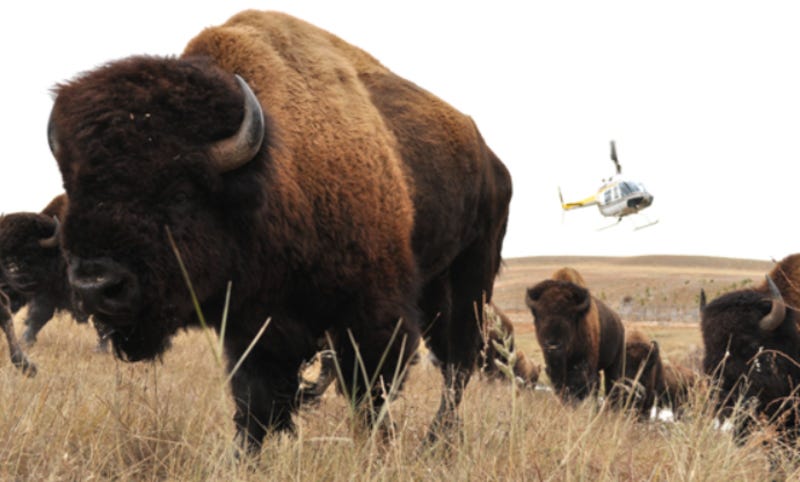
US National Parks Service photo
“It’s a great day for the conservation world. This project will help conserve bison to a greater degree by having another satellite herd in Mexico, where bison are classified as an endangered wildlife species,” said Wind Cave park superintendent Vidal Davila. “Wind Cave’s herd is ideal for reintroduction efforts because of its genetic diversity and lack of domestic cattle gene introgression.”
To win over skeptical cattle ranchers in the region, El Uno opened its doors to the ranchers and invited everyone in the town to celebrate the bison release. “At first we questioned why those crazy people brought the bison back”, said local rancher Manuel Yanez.
But as they start to see results, Yanez and his father-in-law Martinez joined a group of ranchers who adopted sustainable grazing practices and now raise smaller herds. And once the pasture recovered, they no longer had to truck in alfalfa, which was expensive during the drought.
Now grown to 438 bison, the Janos herd is managed by the non-profit Cuenca Los Ojos in partnership with the FMCN. Cuenca los Ojos (Watershed of Springs), founded by conservationist and rancher Valer Clark, is dedicated to restoring wetlands, grasslands, and wildlife habitat on the US-Mexico border. “We bring back Water, Soil, and Life.”
How that came to be is an unlikely - and profoundly hopeful - story that began in 1999 when Valer and her husband, Josiah Austin, went on holiday to Arizona and first saw the El Coronado Ranch. “The land had been grazed so relentlessly that the grasses were depleted, the creeks were dry most of the year and deeply eroded, the soil powdery and parched,” Oprah Magazine wrote in 2012. When the owner unexpectedly accepted their low offer, they suddenly found themselves owners of a 1,920-acre ranch in the Chiricahua Mountains of southeastern Arizona and moved there from Manhattan.
Clark recalled her first summer at El Coronado for Popular Science in 2023. “The monsoon season hit and I was terrified, because I saw how much damage the flooding was doing in the hills. It was a lot of erosion. The vegetation was being flattened. I remember asking, ‘What do the cows eat? Rocks?’”
Local trees had been cut down in the 1800s to fuel copper production. When grass took over, settlers brought in cattle and sheep. Mining and cotton production also took a toll. After each rain, the land became drier, more desertlike; the soil turned to rock; and plants and trees were left high and dry on the rims of canyons.
To control grazing, Josiah moved the cows around the ranch during the growing season and later to other ranches they had bought. And to stop water gouging the road, he built a couple of small rock dams. Then a group of men from Central Mexico taught the Austins how to build rock dams called tricheras and gabions, as their ancestors had done for centuries.
Returning seasonally for 20 years, the men created some 20,000 rock structures which slowed the water flow throughout Turkey Creek’s side channels in the hills. As the low barriers caught sediment and deep-rooted grasses returned, “the mountains became sponges,” Clark recalls. “The wash became a stream, and scientists came and put fish in the stream. Then in 2013, Laura Norman, a physical scientist from the US Geological Survey, found that the barriers had actually raised the stream’s flow by 28%.
The Sky Island Restoration Collaborative, a group of government agencies including the US Geological Survey, nonprofits, private landowners, scientists, and restorationists in the US and Mexico, are building thousands of these slow-water structures.
“By returning soil and water to these lands, we’re now witnessing the resurgence of grass on the uplands and the growth of trees in riparian areas,” said Valer Clark. “This growth plays a vital role in replenishing soil moisture and facilitating a healthy and self-sustaining water cycle.”
“Life here revolves around water. Drawing inspiration from the age-old practices of indigenous inhabitants, we’ve rejuvenated free-flowing rivers and arid wetlands, revived the land and soil, and restored critical habitat for diverse wildlife,” said her daughter, Valerie Gordon, interim executive director of Cuenca Los Ojos. “If water, soil and life can rever negative climate impacts here, it can work anywhere.”
In February 2026, 29 bison were moved from Rancho El Uno to the 51,200-hectare Cuenca los Ojos protected area in northeastern Sonora, marking the return of the species to Sonora after a 200-year absence. It included one of the females who originally came from South Dakota to El Uno in 2009. Without the US border wall, the valley in which the bison could roam would be larger than the Serengeti, says Gordon.
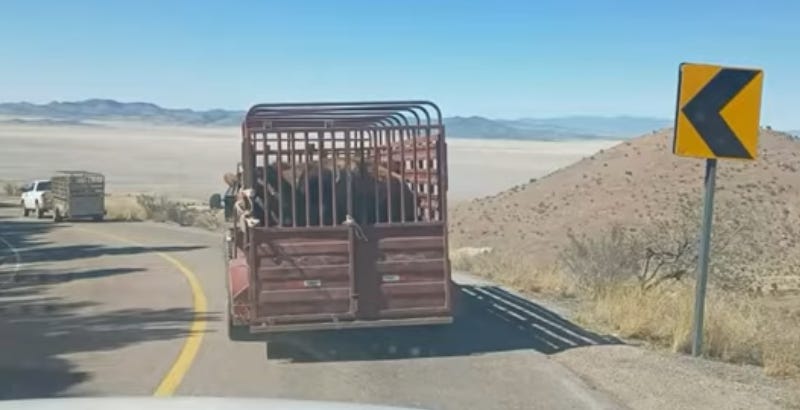
Screenshot from a Cuenca Los Ojos video
El Carmen Nature Reserve
The second herd was established at El Carmen Nature Reserve, which is owned and managed by the Mexican cement company, Cemex, the world’s third largest cement producer. In 2020, 19 American bison arrived from Rancho El Uno. Now about 140 American bison, including the first generation born in the reserve, thrive in El Carmen.
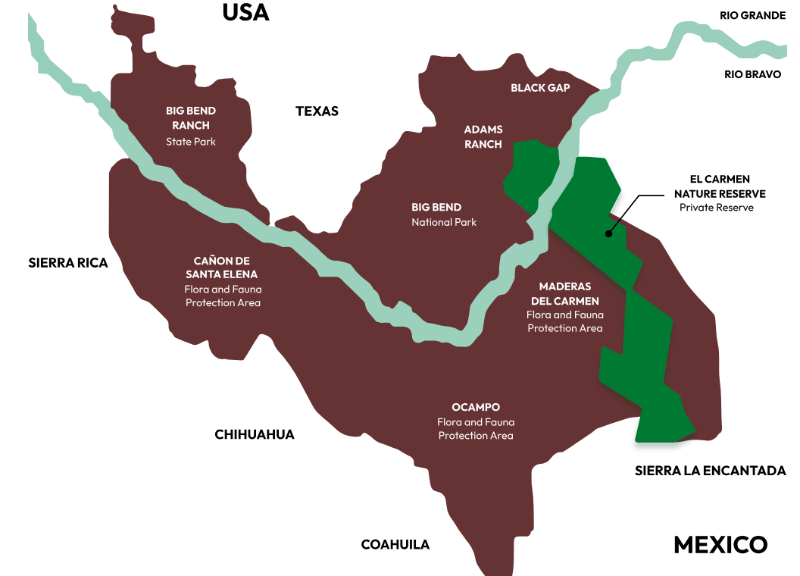
The private reserve began in 2000 when CEMEX bought 136,000 acres of traditional cattle land in Coahuila in northern Mexico. Another step in rewilding an ecosystem that spans the US-Mexico border, it dates back to 1990, when CEO Lorenzo Zambrano was looking for a conservation investment. When the Mexican government declared most of the El Carmen Mountains a “protected area” in 1994, the entire area was still mostly privately owned. But by 2000, many landowners were ready to sell. By 2002, CEMEX had acquired 187,000 acres.
When asked why, CEMEX provided a range of reasons. “There’s the obvious reason – to re-establish wildlife corridors to protected lands in the US,” says Armando Garcia, the man in charge of acquiring new lands for the project. “There’s also the fact that those mountains provide a very important environmental service to both of our countries, and if it is lost there will be serious costs to bear. We understand that service both as conservationists and as businessmen, and we can figure out how best to protect it.”
Now, 26 years later, El Carmen is one of North America’s most biodiverse areas and one of the five great wilderness ecosystems worldwide. A sanctuary for over 1,500 plant species and 450 animal species, it contains five different regional ecosystems - desert scrublands, grasslands, oak forest, pine forest, and gallery forest. El Carmen contributes to the wildlife conservation of 26% of the bird and 16% of the mammal species in Mexico. It has won many awards, including being chosen as Desert Project of the Year in 2023 by the Wildlife Habitat Council.
Experts often call bison “four-legged environmentalists” because of their unique ability to transform uniform landscapes into dynamic and healthy environments. This particularly matters in a time when the climate is changing, because grasslands store up to 45 tons of carbon per hectare, almost all under the soil. “If there is a fire, 10% will be burned but 90% will remain, which, as soon as the rains come, will grow again, unlike forests such as those in the Redd+ program [dedicated to carbon storage], whose carbon reserves are released into the atmosphere when they burn,” says Rurik List.
Bison and other ecosystem engineers like beavers who were once almost eliminated are restoring degraded ecosystems around North America, Europe and the UK, as many videos on YouTube show. Realizing that the grasslands and the bison are inextricably intertwined, many people are hard at work on the slow and painstaking process of restoring them together.
“If one bison herd can save a dying landscape,” asks Terran Works in a recent video, “do we have the courage to let millions do the same?”